
Selected Publications

Personalized Interactive Music Systems (PIMSs) for Physical Activity and Exercise: Exploratory Systematic Review and Meta-Analysis
PIMSs use real-time data and adaptive technologies to align musical features with users’ physical activity patterns, enhancing exercise experiences. This exploratory systematic review and meta-analysis examines their effectiveness across physical, psychophysical, and affective domains.
JMIR Human Factors 2025

Identifying and recommending validated measures to assess depression and anxiety outcomes in the field of arts and health
Interest in arts-based interventions for mental health is growing, but research on their effectiveness remains limited, with existing resources often lacking clear guidance on validated outcome measures. This work offers practitioners recommended measures based on a prevalence analysis in the literature, along with key considerations for selecting appropriate scales.
Frontiers in Psychology 2025
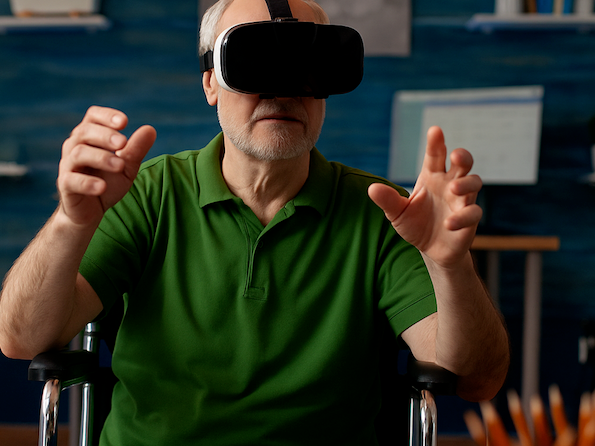
Development and User Experiences of a Novel Virtual Reality Task for Poststroke Visuospatial Neglect: Exploratory Case Study
Visuospatial neglect (VSN) affects spatial awareness, leading to functional and motor challenges. This case study explores virtual reality (VR) as a potential complementary tool for VSN rehabilitation.
JMIR XR and Spatial Computing 2025

AffectMachine-Pop: A controllable expert system for real-time pop music generation
An expert system capable of generating retro-pop music according to arousal and valence values, which can either be pre-determined or based on a listener’s real-time emotion states. The system is tailored for use either as a tool for generating interactive affective music based on user input, or for incorporation into biofeedback or neurofeedback systems to assist users with emotion self-regulation.
AAAI Workshop on Artificial Intelligence for Music 2025

The Impact of Performing Arts on Mental Health, Social Connection, And Creativity in University Students: a Randomised Controlled Trial
University students often face mental health challenges, exacerbated by stigmas that hinder seeking support and treatment. We introduce a participatory arts programme, Movin’ and Groovin’ for Wellness (MGW), that features facilitated drumming and dancing sessions.
BMC Public Health 2025

AI-Based Affective Music Generation Systems: A Review of Methods and Challenges
A review useful for readers seeking to understand the state-of-the-art in AI-AMG systems and to gain an overview of the methods used for developing them, thereby helping them explore this field in the future.
Association for Computing Machinery (ACM) Computing Surveys 2024

Understanding music and aging through the lens of Bayesian inference
With Bayesian inference as an overarching framework, this review synthesizes the literature on predictive inferences in music and aging, and details how music could be a promising tool in preventive and rehabilitative interventions for older adults through the lens of Bayesian inference.
Elsevier 2024

New advances and novel applications of music technologies for health, well-being, and inclusion
Exploring intersections in music technology research aimed at promoting health, wellbeing, and inclusion, investigating how new methods, technologies, interfaces, and applications can enable everyone to enjoy the benefits of sound and music.
Frontiers in Computer Science 2024

Know Thyself: Improving interoceptive ability through ambient biofeedback in the workplace
Interoception, the perception of the body’s internal state, is intimately connected to self-regulation and wellbeing. Grounded in the affective science literature, we design an ambient biofeedback system called Soni-Phy and a lab study to investigate whether, when and how an unobtrusive biofeedback system can be used to improve interoceptive sensibility and accuracy by amplifying a users’ internal state. This research has practical significance for the design and improvement of assistive technologies for the workplace.
Association for Information Systems (AIS) Conference on Special Interest Group on Human-Computer Interaction (SIGHCI) 2023

Intra- and inter-brain coupling and activity dynamics during improvisational music therapy with a person with dementia: an explorative EEG-hyperscanning single case study
This single case study explored within-session differences in musical features and in within- and between-brain coupling between a Person with Dementia (PwD) and a music therapist during a music therapy session.
Frontiers in Psychology: Cognitive Science 2023

AffectMachine-Classical: a novel system for generating affective classical music
This work introduces a new music generation system, called AffectMachine- Classical, that is capable of generating affective Classic music in real-time.
Frontiers in Psychology 2023

MERP: A Music Dataset with Emotion Ratings and Raters’ Profile Information
In this study, we present the Music Emotion Recognition with Profile information dataset (MERP), containing music features, as well as user profile information of the annotators.
Sensors 2023

Music, Computing, and Health: A Roadmap for the Current and Future Roles of Music Technology for Health Care and Well-Being
This article provides an overview of music, computing and health, and their potential contributions to developing music technology for health and well-being.
Music & Science 2021

Music Therapy During COVID-19: Changes to the Practice, Use of Technology, and What to Carry Forward in the Future
The purpose of this survey study is to observe trends in how music therapists from different regions around the world have had to alter their practice, especially in relation to their use of technology during the COVID-19 pandemic.
Frontiers in Psychology 2021

Developing Music Technology For emotion Regulation and Motor Rehabilitation
Medical technology involving music is increasingly being developed for various clinical and non-clinical contexts to support health and well-being. This paper focuses on two recent systems that allow users to steer their own wellness and recovery.
Proceedings of the 16th WFMT World Congress of Music Therapy 2020

A closed-loop, music-based brain-computer interface for emotion mediation
We propose a non-invasive brain-computer interface (BCI) system to feedback a person’s affective state such that a closed-loop interaction between the participant’s brain responses and the musical stimuli is established.
PLoS ONE 2019

A novel music-based game with motion capture to support cognitive and motor function in the elderly
This paper presents a novel game prototype that uses music and motion detection as preventive medicine for the elderly. Our prototype uses music not only to engage listeners, but also to leverage the efficacy of music to improve mental and physical wellness.
IEEE Conference on Games (CoG) 2019

Music and Motion-Detection: A Game Prototype for Rehabilitation and Strengthening in the Elderly
We offer a prototype for a motion- detection and music game to inspire greater engagement and adherence from patients undergoing physical therapy exercises for rehabilitation or strengthening.
IEEE International Conference on Orange Technologies (ICOT) 2017